Most manufacturer websites are built as though a sourcing buyer behaves like a retail shopper. They don't, and the mismatch is why so many manufacturer sites generate traffic but almost no usable enquiries.
What a sourcing buyer is actually doing
A procurement manager looking for elastic tape or 500 branded jute bags is not browsing for inspiration. They arrive with a specification already largely formed, and they are running two checks in parallel:
- Do you make the specific thing I need? Not "do you make bags" — do you make jute conference bags, in the quantity and with the branding I need.
- Are you credible enough to be worth a phone call? Are you a manufacturer or a trader reselling someone else's output? Do you hold the certifications my own buyers will ask me about?
Both questions must be answerable in under a minute, without contacting you. If either is unclear, they go to the next supplier — and you will never know they visited.
Give every product line its own page
The single most common structural mistake is one "Products" page listing everything, or worse, a downloadable PDF catalogue.
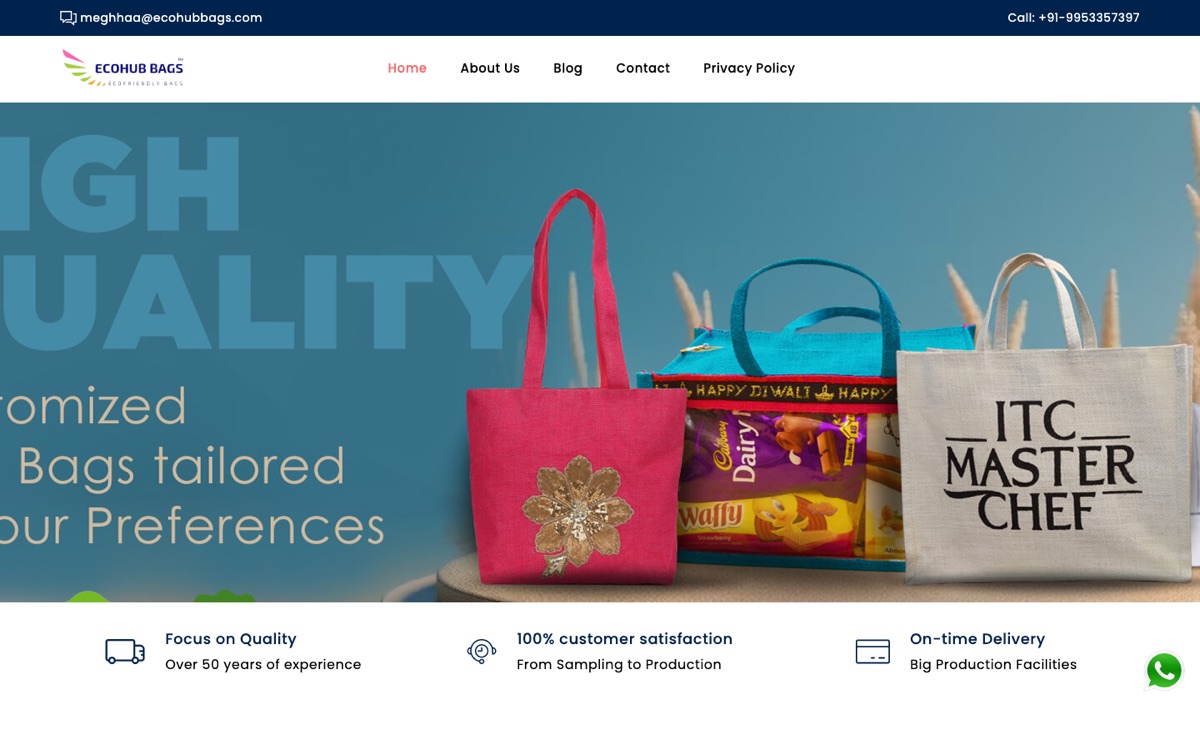
Ecohub Bags manufactures twenty-nine distinct lines — branded jute bags, canvas grocery bags, wedding bags, conference bags, wine bags, laptop bags, Diwali hampers, and so on. Each of those is a separate thing a buyer searches for, and each needs its own addressable page.
Two reasons, and the second matters more than people expect:
- Search. "Jute conference bags manufacturer" is a real query with real buying intent. A page that is about jute conference bags can rank for it. A line item on a combined products page cannot.
- Sales enablement. Your sales team can send a buyer a single URL for exactly the product discussed, instead of a 40-page PDF and instructions to look at page 12. This is the benefit clients notice first, and it has nothing to do with SEO.
Put the certifications where buyers look
Myoho Fabrics manufactures elastic and garment tapes. They hold Oeko-Tex certification, which for a textile component supplier is frequently the qualifying criterion — a garment manufacturer's own buyers demand it, so a supplier without it is filtered out before any conversation about price.
That certificate belongs in the main navigation, not in the footer. We gave it a dedicated top-level nav item on their site for exactly this reason. Burying a qualifying credential in a footer link costs enquiries from precisely the buyers you most want.
The general rule: if a credential can disqualify you when absent, it should be one click from every page.
Show the process, not just the products
The question that separates a manufacturer from a trader in a buyer's mind is "do you actually make this?" Product photography alone does not answer it — a trader can photograph stock too.
A work process section does. Showing how material moves through the mill, what happens at sampling, what the production capacity looks like — that is the content that establishes you as the source rather than an intermediary. Myoho's site is structured around this, and it is doing more work than any product page.
Make enquiry the primary action, and make it specific
There is no cart in this business, so the conversion event is an enquiry — and enquiry quality matters far more than enquiry volume.
An enquiry that says "please send your catalogue and prices" is nearly worthless; someone now has to spend twenty minutes establishing what the buyer wants. An enquiry that says "jute conference bags, 500 units, single-colour screen print, needed in six weeks" can be quoted immediately.
The difference is structural. If the buyer enquires from the specific product page, and the form carries that product context automatically, specification comes along for free. Add a pre-filled WhatsApp link for buyers on phones — in India that is frequently the preferred channel, and expecting a form fill on mobile costs you enquiries.
What manufacturer sites should stop doing
- PDF-only catalogues. Invisible to search, painful on mobile, and out of date the moment your range changes.
- "Request a quote" as the only route to a price. You may have genuine reasons not to publish pricing, but give buyers something — MOQs, indicative ranges, lead times. Total opacity reads as either expensive or evasive.
- Stock photography of factories that are not yours. Buyers in your sector can tell, and it undermines the exact credibility you are trying to build.
- Hiding the phone number. B2B buyers still call. Myoho's number sits in the navigation itself.
A structure that works
- Home — what you manufacture, for whom, and why you are credible, above the fold
- Individual product line pages — one per line, each addressable and each optimised for how buyers name that product
- Process — how it is actually made, with real photography
- Certifications — top-level, not footer
- About — capacity, location, years operating, who you already supply
- Contact — phone, WhatsApp and a form that inherits product context
None of that is complicated. It is just organised around what a sourcing buyer is doing, rather than around what a retail storefront template assumes.