This question gets answered badly in both directions. Agencies that only build custom will tell you Shopify is limiting. Agencies that only do Shopify will tell you custom is a money pit. Both are selling their capacity rather than answering your question.
Here is the framework we actually use, and two real projects that landed on opposite sides of it.
The question that decides it: who changes what, and how often?
Not "how big is the catalogue" or "how much traffic". The deciding question is operational: which parts of this site need to change, who needs to change them, and how frequently?
If the answer is "our marketing team wants to launch a sale on Friday, add twelve products next week, and swap the homepage banner for Diwali" — that is a storefront platform. Shopify exists precisely so those actions do not require a developer.
If the answer is "the product data has relationships our catalogue can't express, and pricing depends on quantity and buyer" — you are describing something a storefront platform models badly, and you will spend more fighting it than building it.
Worked example: Shopify was right
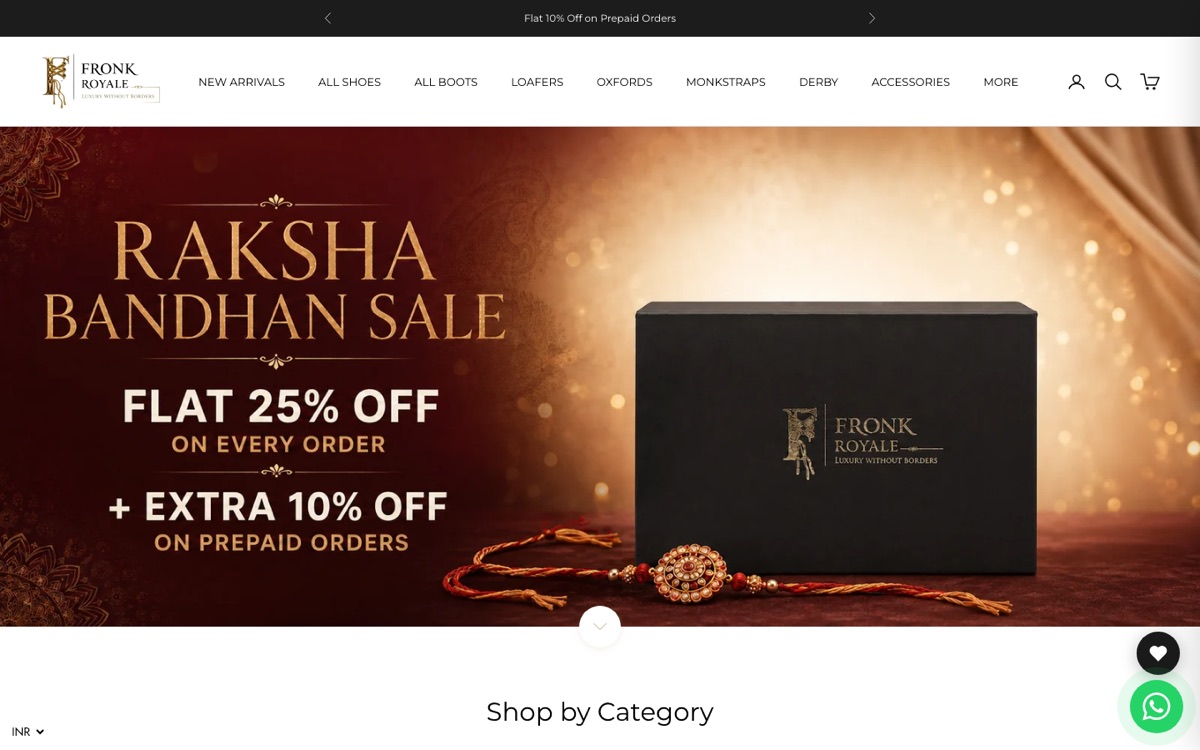
Fronk Royale sells men's leather footwear — Oxfords, Derbys, monk straps, loafers, and several distinct boot lines. Fourteen collections in total.
Fourteen collections sounds like a lot, and people often read catalogue depth as a signal to go custom. It isn't. The catalogue is deep but conventional: products have a price, sizes, images and a collection. Shopify models that perfectly.
What actually mattered was the campaign layer. The brand runs seasonal promotions — a Raksha Bandhan sale with a prepaid-order incentive was live when we wrote up the project — and those need to go live when the brand decides, not when a developer is free. On Shopify, the announcement bar, hero campaign slots and promotional pricing are all editable by their own team.
Had we built that custom, every campaign would have become a deployment. That is the real cost of choosing custom for a business that merchandises frequently, and it is almost always underestimated at the point of decision.
Worked example: custom was right
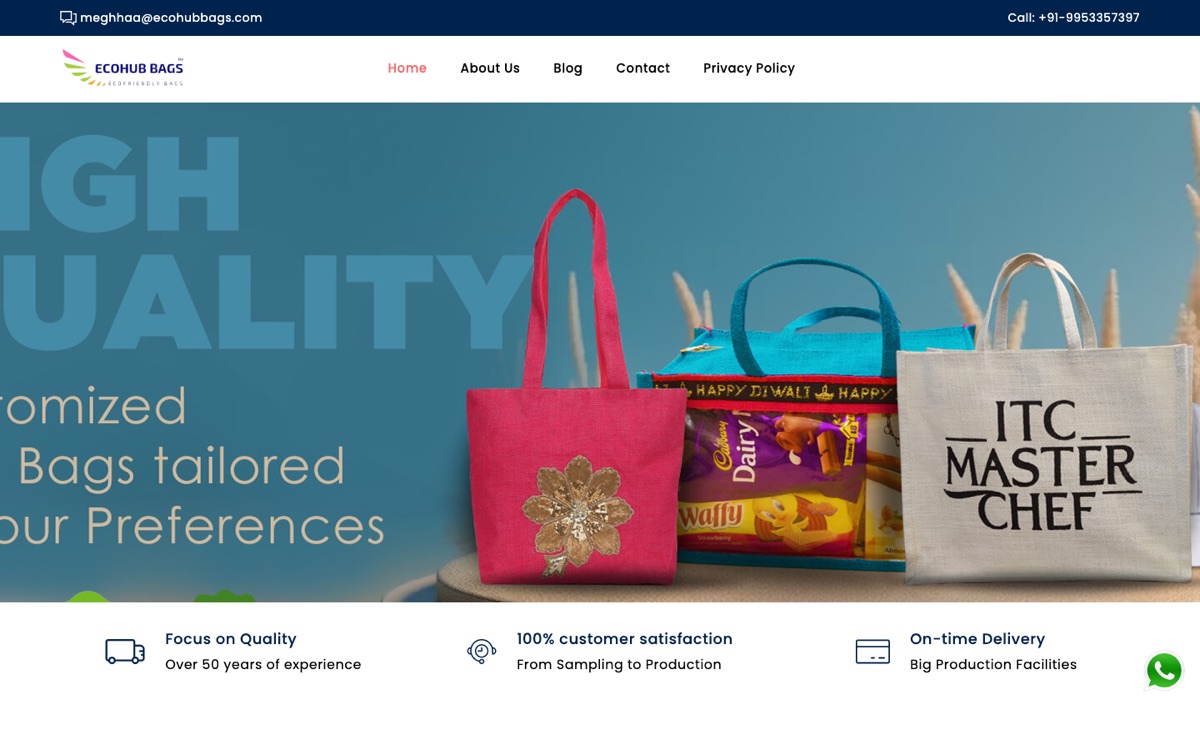
Ecohub Bags manufactures jute and canvas bags in Delhi and sells to corporate buyers. Twenty-nine product lines — branded jute bags, conference bags, wedding bags, wine bags, laptop bags, Diwali hampers.
Superficially this looks like the Fronk Royale case with different products. It isn't, because nobody adds a jute conference bag to a cart. A buyer sourcing 500 branded bags needs to find the exact specification and send an enquiry with quantity, branding requirements and a deadline attached. There is no checkout in this business.
Forcing that into a storefront platform means fighting the platform's central assumption on every page. We built it from scratch instead: the catalogue is organised so a buyer reaches a specific product line directly, and enquiries route through a form and a pre-filled WhatsApp channel so a buyer on a phone reaches a human in one tap.
The measure of success here is not conversion rate. It is whether the enquiries arriving have the product already specified — which is what saves the sales team the back-and-forth that used to happen over email and PDF catalogues.
"Custom Shopify theme" is a third option people forget
The choice is not binary. Between "stock Shopify theme" and "fully custom build" sits a bespoke theme on Shopify's infrastructure — you keep the platform's checkout, payments, inventory and admin, but the storefront is designed from scratch.
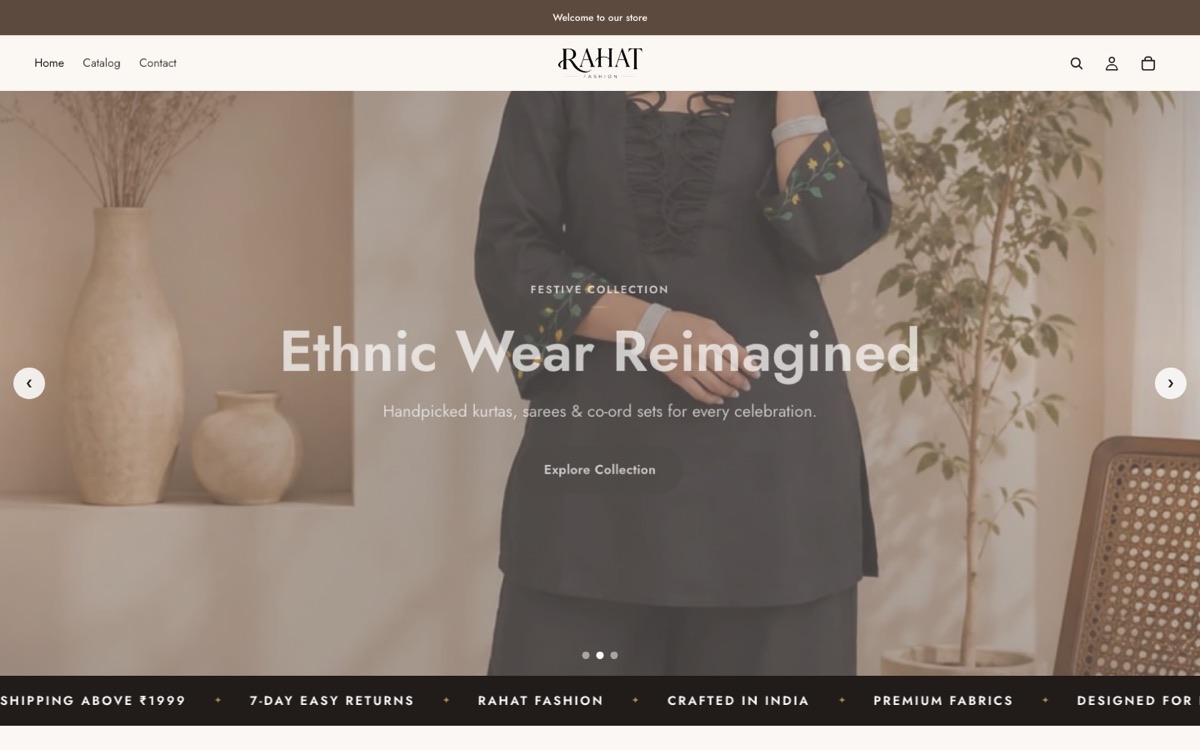
This is what we built for Rahat Fashion, an ethnic wear brand whose brief was explicitly "do not make us look like every other ethnic wear store on Shopify" — a fair complaint, since most of that category runs lightly-restyled versions of the same handful of marketplace themes. Their storefront runs a shoppable video section and occasion-led browsing, neither of which comes out of a template.
For most D2C brands with a differentiated identity and a conventional catalogue, this is the right answer, and it is meaningfully cheaper than a full custom build.
What each option actually costs you
Rather than quote rates, here are the cost drivers that matter, because they are what actually move the number:
- Stock theme + configuration. Cheapest and fastest. You get a working store in days. You look like your competitors, and you will hit limits when you want something the theme's author did not anticipate.
- Custom Shopify theme. Middle. Cost scales with how many distinct page templates and custom sections you need, not with product count. Platform fees continue.
- Full custom build. Highest, and the ongoing cost is the part people miss — you now own hosting, security patching, payment integration maintenance and PCI considerations that Shopify was absorbing for you.
That last point deserves emphasis. The build cost is visible and gets negotiated. The maintenance cost is invisible at decision time and never stops.
When you should ignore all of this and use a template
If you are validating whether the product sells at all, put it on a stock theme and find out. Spending on a custom storefront before you know the product moves is the most common expensive mistake in D2C, and no agency will talk you out of it because it is a smaller invoice for them.
Come back to this decision when you have demand and the storefront is measurably in the way.
A short checklist
- Does your team need to change merchandising weekly without a developer? → Shopify
- Do you have a checkout at all, or is it enquiry-based selling? → No checkout means custom
- Does pricing vary by buyer, quantity or negotiation? → Custom
- Is your catalogue conventional but your brand identity distinctive? → Custom Shopify theme
- Are you still proving the product sells? → Stock theme, revisit later
If you are weighing this up and want a second opinion on which side your business falls, we are happy to give one — including when the answer is that you do not need us.